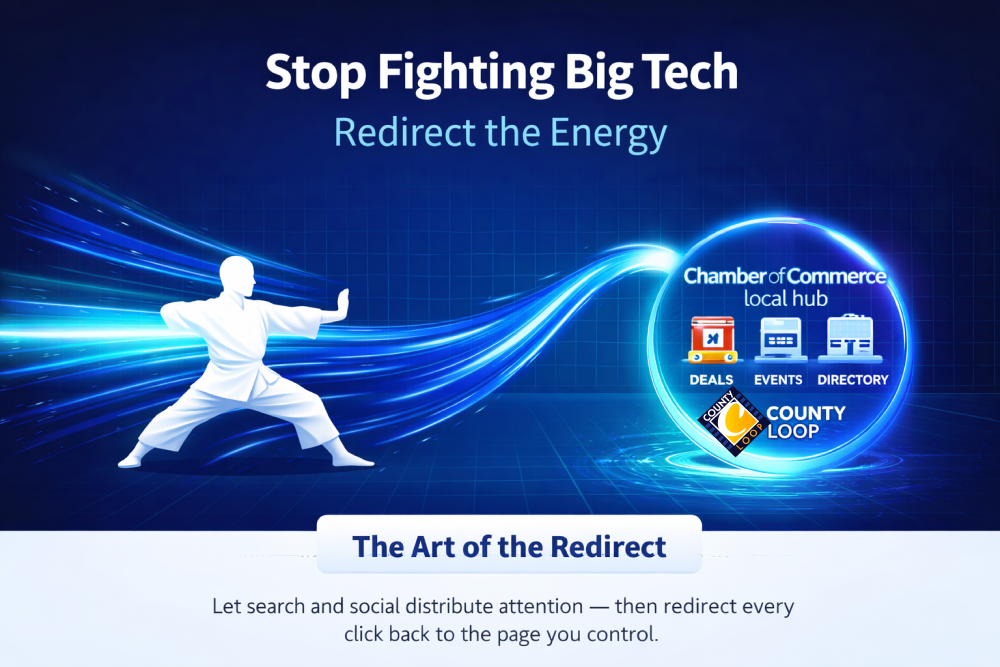
Most small businesses are exhausted by the internet. Google wants you to “optimize.” Social platforms want you to post constantly. Agencies want monthly retainers. It feels like a fight you never signed up for.
Here’s the shift: you don’t win by punching harder. You win by redirecting the energy — and letting it land where you choose.
Most small businesses are paying $200–$500/month just to exist online. This shows you how to stop.
Use Big Tech for momentum. Use your Chamber for control.
Your Chamber listing can replace your website — and your domain can point directly to it.
The uncomfortable truth
Big platforms don’t want you to own your audience. They want you to rent it — forever.
Goal: Reduce cost of doing businessMethod: Redirect attention to owned local infrastructureOutcome: Measurable visibility without the treadmill
Local-first economicsTraffic you can measureAuthority stays localStop paying the internet tax
The Martial Arts Principle Applied to Business
In martial arts, force isn’t good or bad — it just exists. The mistake is meeting it head-on. The smarter move is to accept momentum, redirect it, and let it land where you choose.
Translation: You don’t need to beat Google or Facebook. You need to decide where the attention lands.
You don’t win by outspending the algorithm. You win by choosing the destination.
What most businesses do
Spend money trying to “rank” on Google.
Post constantly on social platforms hoping the algorithm cooperates.
Pay monthly retainers just to keep up.
What works better
Use social platforms as distribution, not as your home.
Centralize local info on a trusted community hub.
Measure results and reinvest locally.
What Big Tech Is Actually Doing
The “internet game” is designed so businesses keep spending. Most owners aren’t failing — they’re trapped in a system where visibility is rented.
If visibility is rented, it can be taken away. Owned infrastructure can’t.
Social platforms
They host attention. They control distribution. Your audience can vanish the moment the algorithm changes.
Great for conversation
Unreliable as a permanent business home
Hard to measure real intent
Search engines
They turn discoverability into a competitive tax. Businesses fight for keywords instead of serving customers.
Great when you already rank
Expensive when you don’t
Incentivizes endless optimization
Key point: You don’t need to fight the platforms. You need to stop letting them decide where your effort lands.
The Art of the Redirect
Big tech has momentum. That momentum isn’t good or bad — it just is. The mistake is trying to beat it. The win is using it.
The rule: Let Facebook and Google do what they already do best — distribute attention — then redirect that attention back to a page you control.
Post less. Measure more. Redirect every click back to a home base you control.
Step 1: Create one “home base”
This is where you want every click to land.
Your Chamber business listing page
Your County Loop listing page
Your “official” local hub page that can be measured
Non-negotiable: Your home base must be shareable, measurable, and updateable — not a static brochure.
Step 2: Use big tech as the “throw”
Post short, tease the value, and send them home.
Post the headline and one photo
Tease the benefit (“Full map here”)
Link back to the home base every time
Example: “Garage sale map is live — download it here.”
“Weekend events list — details here.”
Step 3: Let subdomains handle “tools”
You don’t lose capability — you gain structure.
shop.yourbusiness.com → Shopify / cart
book.yourbusiness.com → scheduling
menu.yourbusiness.com → restaurant menu
etsy.yourbusiness.com → Etsy store
Translation: Your listing becomes the website. Subdomains become the “attachments.”
Step 4: Prove it with measurable results
This is where it stops being “marketing talk” and becomes math.
Track page views and engagement
See which posts drive clicks
Repeat what works
Stop paying for what doesn’t
Outcome: You build visibility you can measure — without paying an agency to “guess.”
The Art of the Redirect in one sentence: Use big platforms for attention, use your Chamber/County Loop page for conversion, and use subdomains for tools.
Publish the full info on your home base page.
Tease the headline on social.
Link back home (every time).
Measure results inside your dashboard.
Repeat what works weekly.
The Simple Move Most Businesses Miss
Now that you understand the art of the redirect, the move becomes obvious: instead of building a five-page static website for thousands of dollars — and then paying monthly just to “optimize” it — you can use a modern, dynamic directory listing as your official online home.
Stop building websites people never visit. Start building destinations people return to.
What a modern listing can include
Business information, categories, and service highlights
Photos, updates, and announcements
Events, deals, and community visibility
Reviews and reputation
Real-time, measurable traffic
Where it should live
Your local Chamber business page
Your County Loop listing
Community hub pages that people actually use
Social media becomes the funnel. The listing becomes the destination.
Rule: Do not publish the full information on social. Publish the headline and point home.
The Self-Funding Flywheel
When you send attention back to your local hub, you stop leaking value to platforms and start compounding it locally. This is how communities become self-sustaining.
When the hub wins, the town wins. When the town wins, the Chamber becomes indispensable.
Publish local value (events, guides, maps, articles) on the Chamber site or County Loop.
Use social platforms only as distribution to drive traffic back to your pages.
Measure results with real traffic and engagement metrics.
Businesses see proof and upgrade for more visibility.
Revenue stays local and funds more content + more promotion.
The community learns the habit: “Check the Chamber site.”
Diagram
The local hub model: social and search distribute attention, but the Chamber/County Loop pages become the destination where value stays local.
Outcome: The Chamber stops being a list. It becomes the place your community goes to find what’s happening and who to trust.
How to Use Your Domain Name With a Chamber Listing
Many businesses already own a domain name (yourbusiness.com). You can use that domain to point directly to your Chamber listing or County Loop page — and stop paying for a separate website just to “exist online.”
Keep the domain. Kill the treadmill. Point the domain to the page that actually converts.
Option A: Forward your domain
Fastest option. Your domain sends visitors directly to your listing.
Log in to your domain registrar (where you bought the domain).
Find “Domain Forwarding” or “URL Redirect.”
Paste your Chamber listing URL (or County Loop URL).
Choose “Permanent (301)” if available.
Option B: Use DNS (more advanced)
Best when you want branded email and stronger control. Your registrar settings determine the path.
Keep your primary domain pointing to the listing (your “home base”).
Create subdomains for tools (shop., book., menu., etc.).
Important: If you want, County Loop can provide a simple checklist for your specific domain provider so you can do this in minutes without confusion.
What This Saves You
Many small businesses spend hundreds per month just to keep a basic website alive — before they spend a dollar on real advertising. If your listing becomes your online home, you can eliminate the “internet tax” and keep that money working locally.
If you save $200/month, that’s $2,400/year back into your business — or your community.
Common monthly costs
Website hosting + maintenance: $50–$200/month
SEO retainers: $150–$500/month
Website rebuilds every few years: $3,000–$10,000+
Simple schematic
Use your listing as the main website, and keep shopping carts/tools on subdomains (shop., store., book., menu., etc.). You save thousands without losing capability.
A smarter allocation
Keep your domain name
Point it to a dynamic Chamber/County Loop listing
Reinvest savings into promotion that drives customers
Example: saving $200/month is $2,400/year that can go into real visibility or lower costs of doing business.
Bottom line: Advertising away from yourself is an expense. Advertising into your local hub is an investment.
Your 7-Day Playbook
This is how a Chamber or business can move from “random posts” to a measurable system in one week.
One week. One home base. One link. Measurable results.
Day 1: Complete your listing (photos, categories, services, contact info).
Day 2: Create one high-value community post (event calendar, weekend guide, or simple map).
Day 3: Publish it on the website as the source of truth.
Day 4: Post a short teaser to social with a link back to the website.
Day 5: Ask members to share the link. The link is the asset.
Day 6: Review traffic metrics and identify what content performs best.
Day 7: Repeat with a second asset (garage sale map, visitor guide, or local directory spotlight).
Discipline: Never post the full content on social. Post the headline and send them home.
Put the Redirect Into Action
Understanding the Art of the Redirect is step one. The advantage comes when you claim your home base and start letting attention land where you choose.
Claim the home base. Then make every post point back to it.
Step 1: Build a free directory listing
Fast, free, and measurable — this becomes your official online home base.
Michael Frear
Michael Frear is a U.S. Marine Corps veteran and founder of County Loop. He focuses on helping Chambers and small businesses reduce marketing costs, reclaim local visibility, and build community-owned digital infrastructure that actually works.